
Propagation by seed of Plumeria sericifolia (Apocynaceae), a species endemic to Cuba with potential for gardening
Article Sidebar
Main Article Content
Abstract
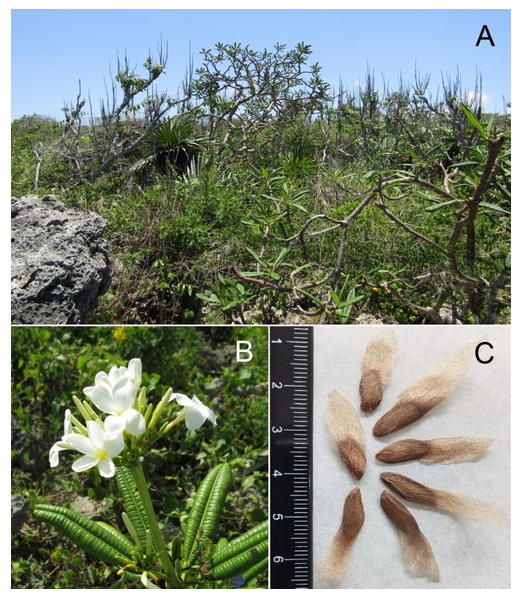
Plumeria sericifolia is a species endemic to Cuba whose distribution is restricted to the west of the island. The plant formations it inhabits are not know precisely, although its presence is know on serpentine and in coastal and subcoastal xeromorphic scrublands. Its conservation category is not yet defined because the data are poor. Nothing is known about the viability of its seeds, morphophysiological characteristics, nor is there a previous germination study. The objective of this work was to determine seminal traits of P. sericifolia that allowed us to expand current knowledge about the biology of the species and contribute to its propagation with ornamental fines, while at the same time serving as a basis for future studies and management and/or conservation programs. Germination was evaluated at a fixed temperature of 25°C in an incubator without light. The seeds presented 7.68% average humidity, developed inverted embryos and more than 50% of the biomass destined for reserves. According to biometric data the seeds of the species are tolerant to dehydration, which would lengthen their survival in natural conditions and allow them to be stored ex situ. The seeds were highly viable and without dormancy, which would facilitate the natural regeneration of the species in the field and the obtaining of seedlings in the nursery. In the futures, further studies on storage behavior and germination under different temperature and lighting ranges should be carried out. Germination experiments under water stress and salinity are also recommended, factors that the species experiences under natural conditions.