
Land snails of the semideciduous forest of Monte Quemado, Sierra del Chorrillo, Camagüey, Cuba
Article Sidebar
Main Article Content
Abstract
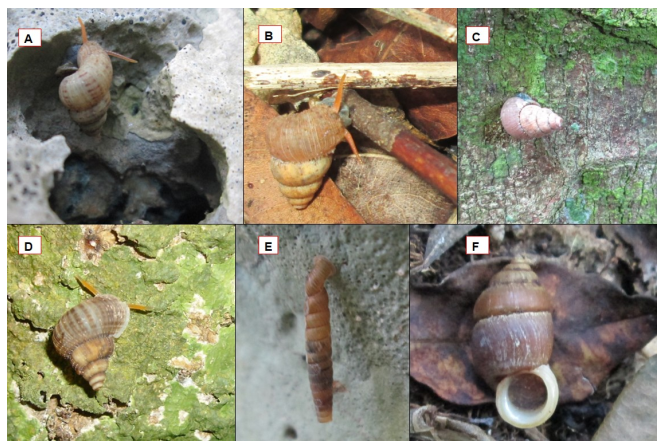
In the present work, we studied the terrestrial mollusk assemblage in the semi-deciduous forest of Monte Quemado, the largest vegetation formation in the "Sierra del Chorrillo" Managed Resources Protected Area. The terrestrial mollusk assemblage of the semi-deciduous forest and its relationship with habitat structure was characterized. The study was conducted in December 2016, 2017 and 2018 and January 2020. Twenty fixed circular plots were sampled, bordering the Monte Quemado elevation. Within each plot, alive individuals and empty shells were recorded (only taken into account in the species list). Within each plot, species richness and density were recorded. Nine habitat structure variables were measured. Twenty-one species were recorded (five species by shells only), of these 90.5 % are endemic, including five local endemics. The terrestrial mollusc assemblage was characterized by little change between years in terms of density and species richness, although there are changes in species composition, but rather in of the rare species. The dominant species were Wrightudora obesa and Farcimen najazaense. The most frequently used substrates were leaf litter and rocks in the lower strata (0-0.5 m). The distribution and abundance of species was influenced by different habitat structure variables. The sites with abundant leaf litter, high ground cover and understory foliage volume in two lower height classes were the most important for F. najazaense y Oleacina solidula. Heterecoptis chorrillensis and Bermudezia eurystoma and W. obesa are determined by a high rock cover and dispersion of trees and abundance of trees of small trunk diameter.
Article Details
Section
Los resultados publicados en la revista Poeyana se presentan bajo la Creative Commons Attribution License, que permite a cualquier lector hacer un uso libre de estos mientras refiera la fuente. No debe, por tanto, incluirse ningún material que no pueda ser publicado bajo estos términos, por ejemplo, fotografías con Copyright. Todos los datos o materiales extraídos de un trabajo escrito por otra persona, se deben identificar con claridad y atribuirse a sus autores, aunque no se hayan publicado o no se hayan citado palabra por palabra.