
Spatial matrix of butterflies in coastal sites and keys from north central Cuba
Article Sidebar
Main Article Content
Abstract
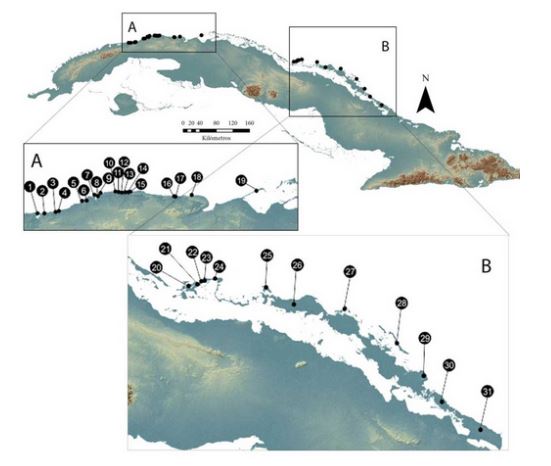
Coasts represent very dynamic and highly modified areas due to both human activity and natural events. Connectivity among their populations is vital for their resilience and preservation of ecosystem services like pollination. Butterflies are considered an essential group offering this service, as well as possible indicators of ecological corridors, which are areas of spatial connectivity. In this study, butterfly composition and taxonomic structure is analyzed in 19 coastal sites and 12 keys in north of central Cuba. The work hypothesis suggests that a spatial matrix structured by metapopulations, along with very connected species, low compositional replacement, nested structure, low level of modularity and spatial selectivity, high robustness in the relation sites-taxa, and resilience after environmental perturbations, would allow to infer that the spatial matrix may represent a natural ecological corridor. On this basis, butterfly composition was classified in rare, low frequent, frequent and very frequent species. To measure compositional changes throughout the matrix, there were used different combinations of beta diversity, as well as the nestedness level. With the species richness by subfamilies, an analysis of spatial modularity and connectivity was conducted. In the two regions studied, the localities of Canasí, Hicacos Peninsula and Coco Key are important for their species richness and for constituting good spatial connectors, the latter two, in spite of having intense tourist activity. The results coincide with the expectations of the working hypothesis and it is concluded that the spatial matrix analyzed constitutes a natural ecological corridor.
Article Details
Section
Los resultados publicados en la revista Poeyana se presentan bajo la Creative Commons Attribution License, que permite a cualquier lector hacer un uso libre de estos mientras refiera la fuente. No debe, por tanto, incluirse ningún material que no pueda ser publicado bajo estos términos, por ejemplo, fotografías con Copyright. Todos los datos o materiales extraídos de un trabajo escrito por otra persona, se deben identificar con claridad y atribuirse a sus autores, aunque no se hayan publicado o no se hayan citado palabra por palabra.